


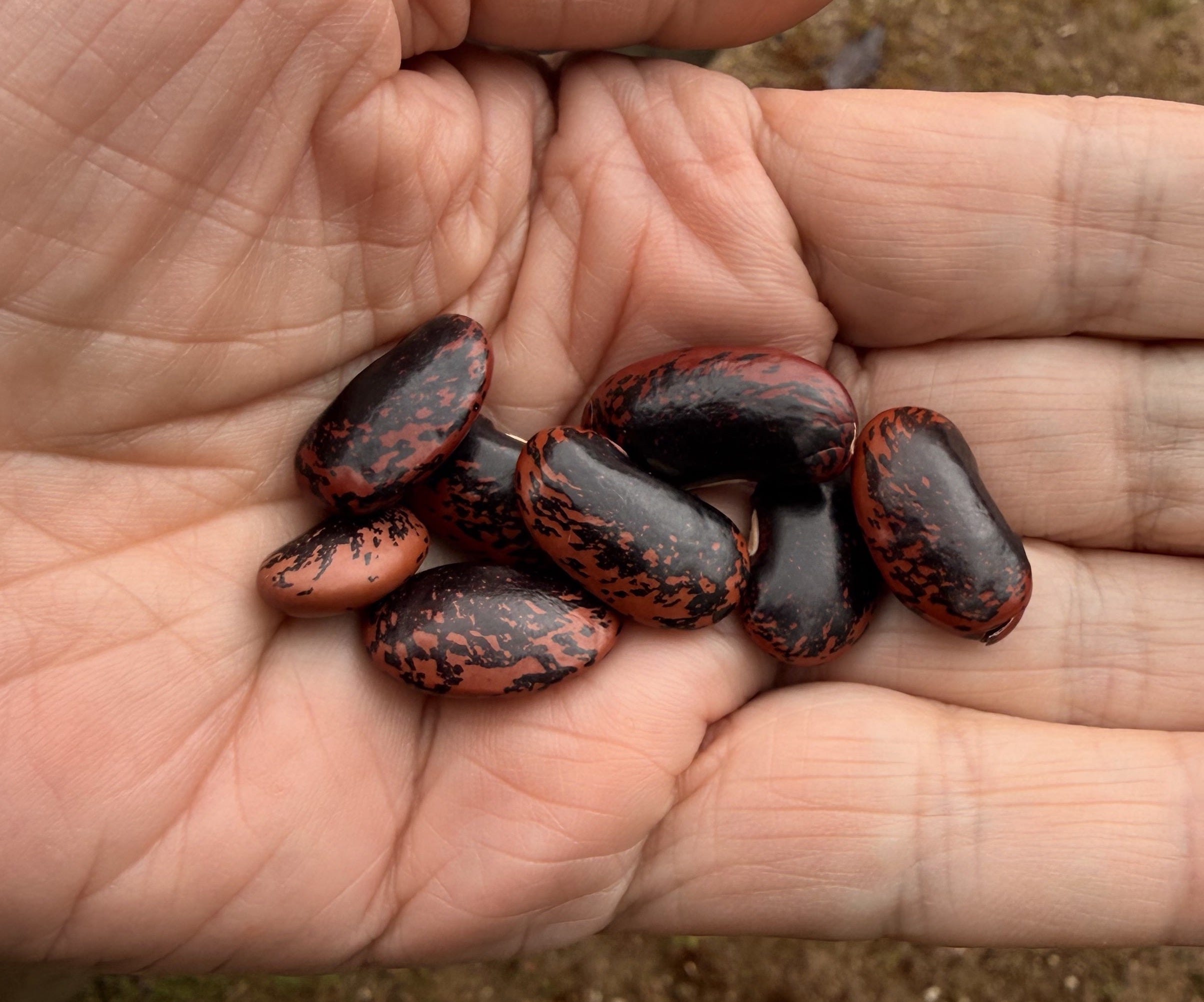
Have you held a Mexican Jumping Bean on the palm of your hand and felt it begin to vibrate with life? Your warm skin rouses it like an artificial sun, coaxes it out of its dormancy. Soon the round bead is rolling around your hand in a joyful dance.
This is not the soft thrum of a plant embryo within its hard seed case. It is the protesting larva of a small moth1 that has eaten the contents of its little abode in the seed pod of a Mexican shrub, and is now fussing, captive in its overheating bed, trying to roll its temporary home away from a heat source threatening to cook it en Cassoulet.

In another hand, my hand, poised over a prepared bed of rich soil is a fistful of Scarlet Emperor Runner beans and they are also alive, waiting and alive. Lustrous with a hard protective wax, their shine rivals the finest carnauba work. They are alive, I say it out loud, here in the garden on my knees, humbled by the continuous creation, wanting to feel a perceptible vibration of the ancient web that pulses through all the life on earth without pause.
A complete plant embryo is folded into its distinctive bean shaped seed case with an embryonic root, to strike into the ground to anchor and hydrate the future plant, and a shoot to stretch skyward to make stems, leaves, tendrils, flowers and fruit out of the light and carbon it finds in the rare air of earth. There is even a small lunch pack of elemental leaves storing energy for the launch. Like the oak tree waiting in an acorn, a scarlet runner bean plant and it progeny wait in this bean with its mahogany brown sheen.
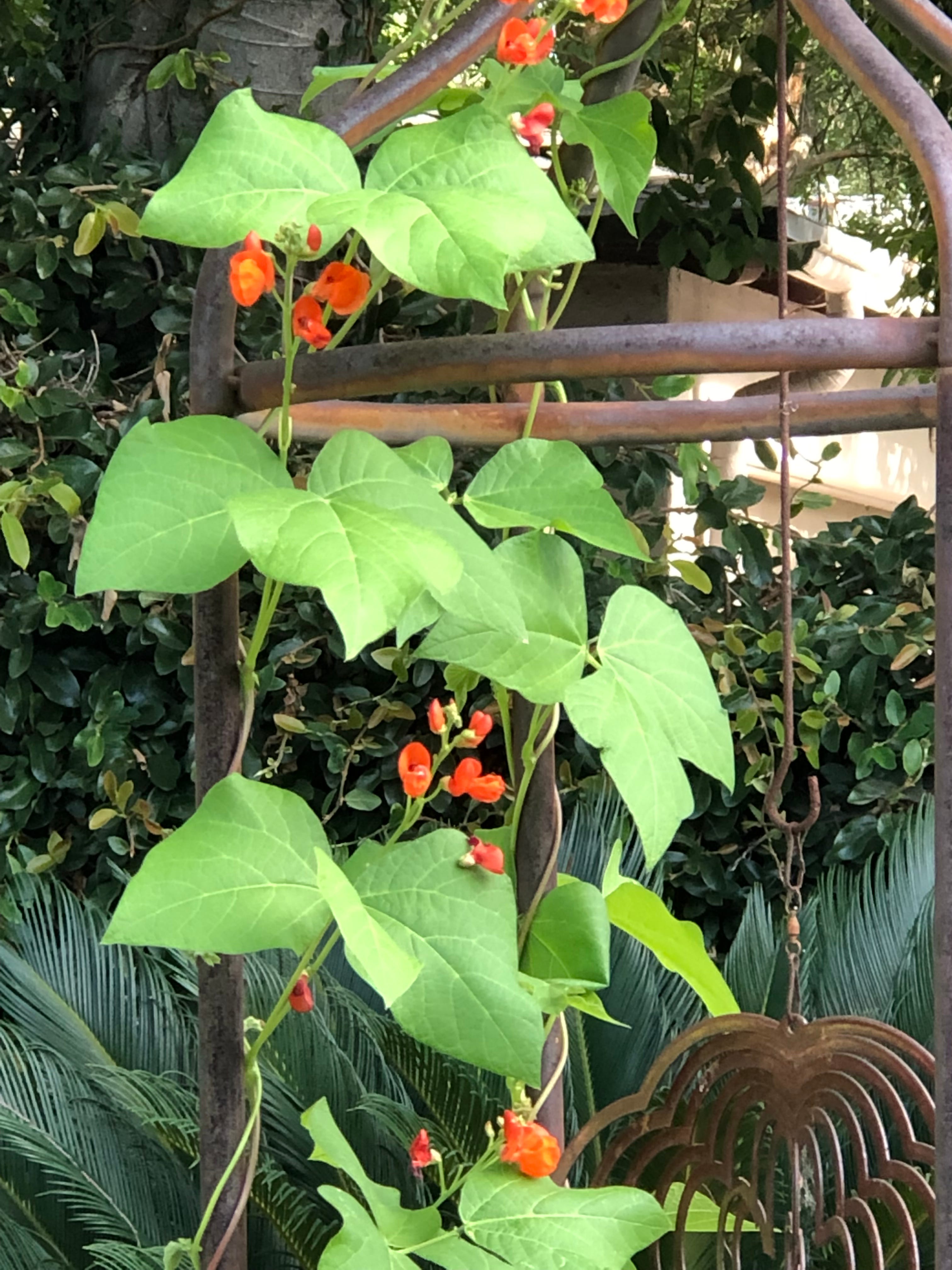
I cover the seeds with soil, water, wait and watch. There is no instant gratification in planting seeds, but there is high anticipation. How does the seed know it is out of the paper packet and in the ground and the time is right to take its one shot and lay claim to a spot of ground to anchor itself? From above, over days, I will see cracks in the soil surface as the root grows and widens with ancillary roots seeking more water. A mound swells and suddenly the stem will lift and unfold green leaves into the sunlight.
In the dormant, but very alive seed is a “decision making center”, a cluster of cells at the growth tip of the embryonic root. These cells are gathering information from other cells about the impact of the seed’s surroundings on two hormones within the seed--one encourages dormancy and the other germination. Critical to the tipping point is the temperature of the surrounding soil and with a consensus of cells, the ‘decision making center’ will pull the switch and the root will orient with the pull of gravity and plunge down into the soil.2

Do you hear that careful language, “decision making,” “gathering information” and “consensus of cells.” These are words of precise description used by researchers tiptoeing around language that might imply intentionality and self consciousness in plant life beyond the internal communications of an organism’s cells. Both the worm in the Mexican Jumping Bean and the cells within the tip of the embryonic root of the Scarlet Runner Bean rock their boats.
At some point in life’s early beginnings on earth, the scarlet runner bean, the smalll Mexican moth and the human race shared common ancestors that had evolved to reproduce and adapt to terrestrial life. Our ancestral paths parted far back in time, but we share life, we share lives on this planet because of those ancient creatures. It is estimated that 40-60% of our genetic code is shared with plants through our ancient common ancestry.
These are not the genes that we associate with inherited traits, but the genes governing common fundamental biological processes like cellular metabolism, DNA replication and protein synthesis. While I recognize the branches where these three beings show up on Earth’s Tree of Life are distant from one another in time and development, but it still affirms something deep for me that all are on the same tree of life.



I didn’t plant many seeds as a girl, but I watched an old orchard come alive in spring—wild radish and wild carrot, leaf buds and blossoms on tree branches, tall grasses and soft smooth baby lizards. I didn’t know how or why, I just accepted the magic as part of my life, like the inheritance it was. When I first saw Golden Poppies, they burst into bloom on their own. I didn’t need to know in my head that I was related to these flowers in a distant past. Instead I knew a deeper truth, I was part of a beautiful world, connected.
Adulthood, more botanical knowledge, poetry and a spiritual life have confirmed what I knew already as a child. Each is a different knowing, but I like to let each lead me back to that elemental grace of a child’s world. I belong, I am part of the whole, an expansive, holy, beautiful beyond. There is a connection, the how and why don’t matter as much as the connection, the belonging in a shared space and a shared life and a yearning to live in its peace.
The Mexican Jumping Bean is the seed pod of a Mexican shrub Sebastiania pavoniana (native to Sonora/Chihuahua) containing a single larva of the moth Cydia saltitans.
Schlanger, Zoë, The Light Eaters, (2024), p. 56.
And with this thought, both hopeful and reverent, I step into my day. At home snow buries all things that will be green, but here in Me ico it’s a verdant world.
Worms in beans~seeds, cells
in seeds~roots, hormones in cells.
Life rocking her boat.