


I still have this one river on my mind that starts at Tuolumne Meadows in Yosemite National Park. This is Part Two of the story of how the Tuolumne River has wandered in and out of my life for 60 years. You can read "One River" Part 1 here. In the writing of this second section I discovered there is a Part Three. Today you join my daughter and I on our three day journey into the Grand Canyon of the Tuolumne in 1996. Next week, join me as I remember a favorite backpacking journey in 2004 with my late husband Bernie. Same river, gentler journey.
In August 1996, my 12 year old daughter and I set out from Tuolumne Meadows to follow the river to Glen Aulin High Sierra Camp to stay two nights.1 I often revisit those moments —in summer, in August. I'm grateful for a brief journal that saved the details or all there would be left are memory's broad strokes. We got an early start on the 6.3 mile hike, never far from the river, walking through meadows of late wildflowers and then lodgepole pine forest, sometimes crossing broad granite slabs and catching vistas of granite domes through the trees. Since 1984, the Tuolumne has been designated a Wild and Scenic River, and we were headed toward some of her wildest and most beautiful country, the Grand Canyon of the Tuolumne.2
Glen Aulin means beautiful valley in Gaelic and the name and the language fit this enchanted place
At the three mile marker, the river began to descend and the trail to dip and bend. Even when we were not next to the water, we heard its roar. I recall the pleasure of watching my child, on the cusp of womanhood, scamper over fallen trees and boulders and scramble down the path, while I slowly climbed over the obstacles. We came to a foot bridge with larger creeks feeding the fuller, faster river. Steeper sections of the path were paved with stone steps like a giant's staircase. Tracking the river, we continued the drop in elevation, passing Tuolumne Falls and further on, the White Cascade which formed a pool near the camp at the head of a valley. We had arrived at Glen Aulin HSC, first established in 1929 and marking a backcountry trailhead.
We left our small packs in our narrow tent cabin furnished with four cots, two lengthwise on each side. There was no electricity, only candles, and compost toilets a delicate distance away. Glen Aulin means beautiful valley in Gaelic and the name and the language fit this enchanted place. The glacier flattened terrain tames the river and it meanders through a denser forest adding the heftier sugar pines, white firs, and Jeffrey pines to the ever-present lodgepole pine. Occasional pocket meadows are clutched by rings of quaking aspen, still summer green and trembling.
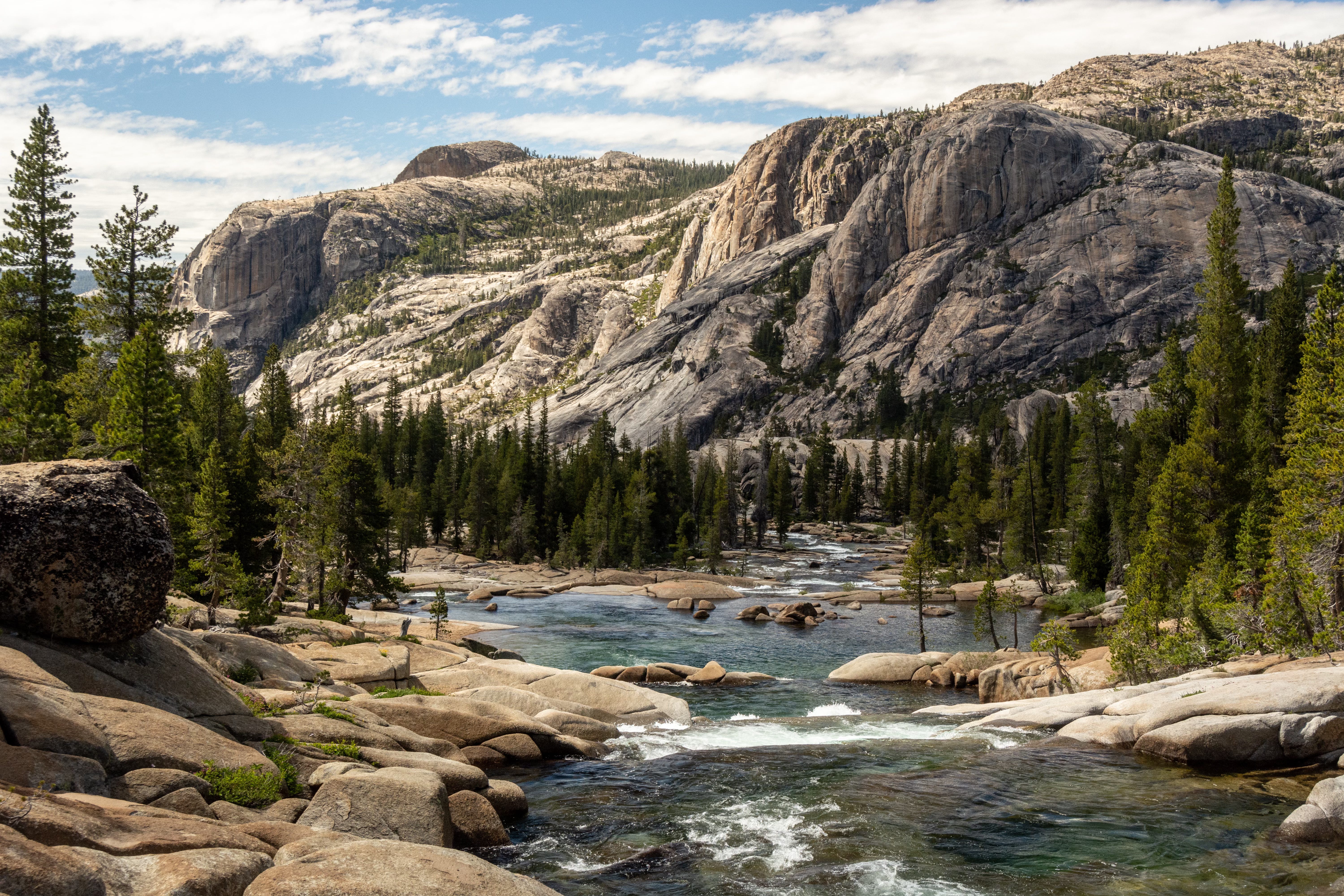
In the distance, downriver, we could see where the Tuolumne follows the path of its ice river predecessors. Over millennia it has carved a deep V shaped canyon between granite walls that rise high above the forest canopy. Carved by past glaciers, the irregular walls assume statuary shapes, marking the canyon entrance like silent sentinels. It is the Grand Canyon of the Tuolumne and our destination the next day.
At the communal dinner, we shared stories and plans with other hikers, many on the High Sierra Camp Loop, 6 nights in different camps in a 51 mile weeks trek. One 71 year old woman, Vi, was on her 22nd HSC loop. Another loop hiker, Nancy, was in our tent cabin for the night, as was Maria. At dinner independent backpacker Maria commented that whenever she heard the term, 'on the loop", it made her think of being 'on the pill.' Maria was memorable, braided hair and an unclear age. She was strong, warmly described by an hiking acquaintance as part mountain goat. She had been backpacking for decades on many continents, she knew the stars in both hemispheres. She was generous and matter of fact and from her we learned that "Marmots like antifreeze" as well as a great deal about the night sky.
We tucked in for the night. As I write today, almost 30 years later, I smile to see the note in my journal from the next morning, "Slept well. Feel so happy." It was a tender time, I was recently divorced and didn't always feel so fine.
We got out again early for our day hike to Waterwheel Falls, dropping about 1000 feet in less than 2 miles, returning by a climb back up. The trail began through the stunning forest surrounding Glen Aulin. We had seen it from above at camp and now under the canopy and up close we smelled the vanilla scent of the Jeffery pine bark, saw corn lilies and even a hummingbird. Still under Glen Aulin's spell, the river paused in emerald green pools that glowed in the early morning sun. The valley narrowed and the granite guardians towered above us.
The trail suddenly steepened as the river plunged down at the valley's edge. Every time we came close enough to see the river, it was pouring over granite boulders in cascades---California Falls, Le Conte Falls and many unnamed in between. The water slid over uneven granite projections and the interruption of the fast flows created dramatic backsplashes. Our trails final descent, next to the long Waterwheel falls was very steep with stone steps built into the trail. All morning we walked in an enchanted landscape. In the narrow canyon, the river and its rocks both sang and roared in their tumbling and both sparkled in the sunlight. Near the river you felt the cool mists in the air and any distance away, the sun was hot and bright.
We were waiting for the dinner bell, when a middle aged man with a neat beard poked his head in the tent flap and joined us. Jim introduced himself as our new roommate.
We made our way back to camp, slowly because we had all day and because it was very steep. Now that we could see the cascades from below and they looked more like waterfalls . On return to camp we learned the shower wasn't working, so we returned to the river to wash off as best we could, frustrated that we had not brought bathing suits. We met Maria there also rinsing off her day hike, but well prepared with a suit. We all returned to the tent cabin and saw that a new tent mate had left a neat pile of belongings on the empty bed.
We were waiting for the dinner bell, when a middle aged man with a neat beard poked his head in the tent flap and joined us. Jim introduced himself as our new roommate. He described himself as "one of the mule people" since he was on a HSC loop on mules. He was good natured and comfortable with his odd billeting, so we were too. Maria calmly summed it up, "I always thought they should do away with this gender stuff". It turned out the camp was overbooked and we learned at breakfast, some people had to sleep in the linen closet.
Later in the evening, my daughter and I had a plan to watch the stars and had scoped out a large flat boulder under a wide expanse of sky. Maria and Jim wanted to join us, so we all scrambled up onto the boulder in the pitch dark night and stretched out on our backs while our eyes adjusted to the glittered sky. It was a clear night, the Milky Way smudged across the expanse and we watched planets, constellations, falling stars and satellites as we shared bits of night sky lore and stories and sometime just lay quiet together in the starlight.
The next morning I woke up at about 6:00 and slipped back to the boulder and watched the sun light up the mountain slopes. The north wall of the canyon threw a shadow across the river and as the sun rose, I watched the light move across the tree tops and finally begin to illuminate the river with rust and green colors, reflections of the iron stained granite and trees. I was watching that commonplace marvel, the recreation of Day.
Later we said our goodbyes and my daughter and I retraced our steps along the river back to Tuolumne Meadows. I still go to Tuolumne Meadows whenever I am in the Eastern Sierra, now sometimes with grandchildren. I take off my shoes and socks and soak my tired feet in the icy waters of the Tuolumne River and rest at the top of the world.
I hope you have enjoyed this river tale. If you liked it, check the little heart and do leave a comment. I love to know who is reading and if my story made you think of one of your own. Next week, I hope you will join me in a final Tuolumne tale about a backpacking adventure in 2004 with my late husband, Bernie, up Lyell Creek Canyon and the headwaters of the Tuolumne. Check out my favorite posts this week below the footnotes.
High Sierra Camps (HSC) in Yosemite National Park. COVID 19, wildfires and heavy snowpack have had an impact on the continued viability of this unique backcountry experience. The 'HSC loop' for 2024 was only 5 days and 3 camps, Vogelsang and Merced were suspended. I've never been to Merced, but Vogelsang is perched at 10,300 feet, and you feel like a nested bird. A light pack, two fresh food meals, water and a bed at night leave lots of energy and time for adventure and/or relaxation.
The camps began operation in 1923, variously added and moved to the current 5 backcountry camps and Tuolumne Meadows Camp.For more information.
Backpacking has also become more popular in the 30 years since my experiences. The Glen Aulin Trail and the Lyell Creek Canyon in Part Three are both part of the John Muir Trail and the Pacific Crest Trail. On both August trips, 1996 and 2004, we saw very few hikers or campers on the trails. I don't know if that would still be the case.
Wild & Scenic Rivers Act was adopted in October 1968, declaring it "to be the policy of the United States that certain selected rivers of the Nation which, with their immediate environments, possess outstandingly remarkable scenic, recreational, geologic, fish and wildlife, historic, cultural or other similar values, shall be preserved in free-flowing condition, and that they and their immediate environments shall be protected for the benefit and enjoyment of present and future generations.”
Sections of the Tuolumne River were designated covered by the act in 1984. Those sections extend from the headwaters in the Eastern Sierra to the eastern end of Hetch Hetchy Reservoir, excludes the Reservoir, and is again designated wild and scenic below O'Shaughnessy Dam until it is dammed again in the San Pedro Reservoir for agriculture in the Central Valley of California. For more information.
The O'Shaughnessy Dam was built to dam the Tuolumne in Hetch Hetchy Valley in 1913. Like Yosemite Valley, Hetch Hetchy was once a magnificent glacier carved valley, with towering cliffs, waterfalls and a quiet valley floor and was said to rival Yosemite Valley in beauty and was also home to many indigenous peoples seasonally and year round. Under the Raker Act, San Francisco was permitted to build the dam. Led by John Muir, preservationists and more than 200 newspaper editorials nationwide opposed the legislation, but San Francisco got the act through Congress. San Francisco still gets most of its water from the Hetch Hetchy Reservoir.
The outcry continued and three years later, Congress passed the National Park Service Act ensuring that national parks would be preserved and management for public enjoyment. Hetch Hetch is the only time such development has been allowed in a NP and it also strengthened the nation’s conservation movement.
Leslie’s Favorite Posts read this week On Substack
- Noted - Writing on Substack, I’m trying to keep track of more information and this was a great refresher for me. She also takes deep dives into Notekeeping by famous people. Something new is coming-looking forward to it.
Removing dams restores fish, river ecologies and much more on
Green Dispatch —Good News for rivers! Seems appropriate to the story above.Reciprocity:the interview Interview of
by on Julie’s substack Homecoming : I have read Nina’s award winning collection of related stories, In This ravishing World and highly recommend the book and the interview with Nina.
Beautifully written. Thank you for the journey. 🙏
This is extremely soothing to read, and reminds me that I have not been spending enough time in nature this summer. Thank you for this beautiful nudge. Looking forward to the third post about the river. 💚