



Aging has surprised me with a motivation to simplify and slow down. I think it began during the early pandemic, pre-vaccine months when I spent all of my time alone, whether inside or out walking. I had no responsibilities beyond my own self care. As a lifestyle, it felt like coming home to my prior life as a 10 year old, except I fixed my own dinner. I missed my family and being hugged, but my world began to refill with wonder, the everyday kind.
A wondrous world is all around us, but we have to pay attention. Children are naturals, we marvel at their delight with the simplest pleasures in bubbles, mud, puddles, bugs, any and every thing around them. Then creeping maturity and adulthood tax our free time and our priorities and we can lose sight of wonder. Being fully present in a moment becomes fraught, the easy connection with our senses gets frustrated and sometimes even lost.

After vaccination, in the ebbing pandemic, I knew I wanted to continue to live with that everyday grace of wonder. I was intentional about what activities and responsibilities I added back into my life. I returned gratefully to family activities and the magic hugs from grandchildren and to other activities, but I guarded the time to cultivate my garden and friendships, read and putter around. Those pastimes have continued to have a high priority. Like my ten year old self, I have no obligations to fulfill, except those make myself.
In this slower paced life, I am more connected with a few trusted friends and attune myself to seasons and transitions of my garden and the natural world. I listen and explore curiously when I notice a bird or plant or something I don’t know or understand. I began to write about these curiosities and how they intersect with my life. I began to share those thoughts on Substack and explore new interests like slow reads of classic literature.

One of my growing interests is birds, in the backyard and on walks, everywhere I go. Over the holidays I treated myself to a good pair of binoculars. I remember comments when the Hubble Space Telescope launched that its impact on the field of astronomy was the equivalent of Galileo first putting his eye to a telescope! My binoculars are likewise changing my relationship with the world.

My inaugural trip with the binoculars was to Morro Bay on the Central Coast of California. I never thought that I would be able to watch birds so close up and it is such a different experience when you are able to watch their behavior and interactions. I had seen it in photos, but didn’t think I would ever see that clearly in the wild. I am finding that using binoculars utilizes and develops the same habits as listening to someone share a story with you or being present in the world with alert senses.
Binoculars give you focus and let you closely examine something from a distance. After I’ve located a bird and I find it with the binoculars, I am able to really watch the bird without disturbing or interrupting its behavior.
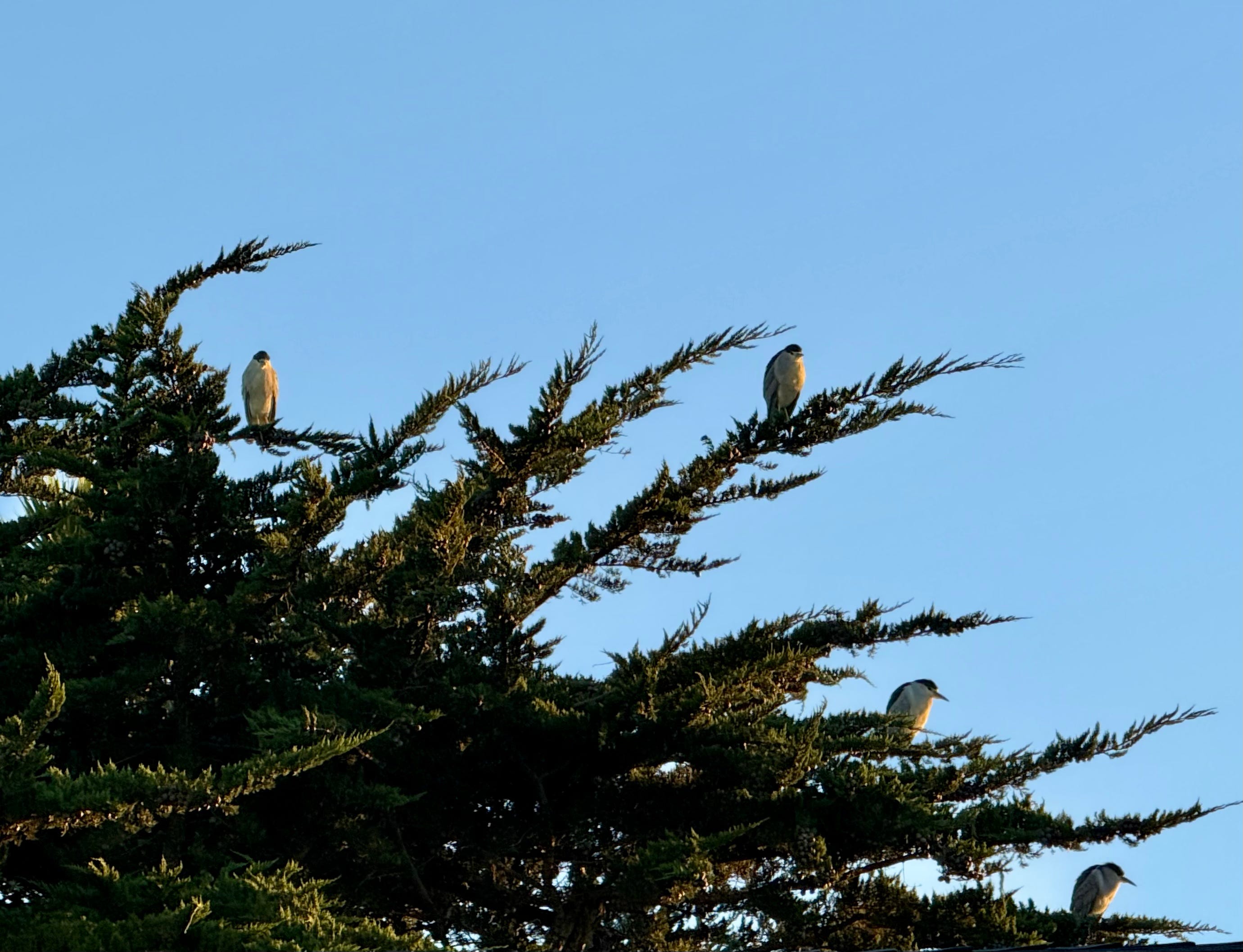
Just after sunrise, I was watching birds on the shoreline and I saw four good sized birds land nearby in a cypress, as if returning to assigned seating in the tree with raspy scolds. Their postures identified them as herons and with the binoculars I could see the coloring of Black-crowned Night Herons including the black caps on their heads. The behaviors of the four birds also matched their social habit of colonial rookeries.

While you are studying natural behaviors of animals with binoculars, sometimes for an extended time, you feel like you are right next to the creature. You are far away, but there is an intimacy. There is beautiful detail with good binoculars. Whether I’m looking at a bird or a flower, the magnified lighting gives clear definitions to feathers and textures.
I was watching a dark bird on a pine bough, slightly shaded, so to my naked eye it just looked like a black bird. I couldn’t see any color markings on it, no red on the wing, the beak and eyes were hidden. Then I looked with the binoculars, and there was a purplish green shimmer on the feathers on its back, an iridescence that I could never have seen without the binoculars. This detail of color identified the bird as likely a Brewer’s blackbird.
The experience left me feeling grateful for that glimpse of something beautiful, that seemed more so for being hidden and secret. It reminded me of listening so closely to someone that you empathically understand their emotions and you are able to reflect back to them what you have heard and understood. A connection.

A shadowy thought has crossed my mind: if someone watched me this closely from far away with binoculars, I would feel violated. Surveilled.
But the bird doesn’t know I’m here - its unawareness is what allows its naturalness. If it knew I was watching, it would be alarmed and would flee for safety, not from offence. I’m not gathering information to use against the bird, not studying it to control or predict, not hunting it. I’m simply marveling at the purple-green shimmer that exists whether I see it or not.
Still, the parallel unsettles me. When does attention feel like appreciation versus violation?

If you enjoyed the post, but aren’t ready to subscribe, you can also show appreciation here by helping me pay for birdseed.
I love this notion reminder of the value of returning to childlike wonder.
I’ve recently found myself needing to start over on a number of levels. I was talking to a dear friend about the different lenses through which I needed to decide if this or that path would work. “And the lens of joy,” she remarked matter-of-factly,. It hit me that I hadn’t even thought of this, rather I was focusing solely on the “ practical.” I think I’ll add joy and wonder. Thank you, Leslie.
I really enjoyed this, Leslie. This morning I was delighted to catch sight of a charm of oriental greenfinches, a bird I'd rarely seen here before. Such a delight.